
At-home alternatives to spa treatments are becoming more and more popular so we wanted to do a little experiment on one of them: Dermaplaning.
For those who are not familiar with what this service consists of, dermaplaning is an exfoliation treatment that removes vellus hair (peach fuzz) and dead skin cells/debris buildup. A licensed provider applies oil to the face and takes a medical grade scalpel across the skin at a specific angle to ensure comfort and a smooth glide. Blades are replaced throughout treatment to minimize discomfort and reduce the risk of nicks or cuts. By removing the peach fuzz and superficial layer of skin, your face looks brighter, feels smoother, and improves skincare product penetration and makeup application.

Professional scalpel & plastic razor used in the experiment.
The tools available for at-home dermaplanes are very different than what is used in a professional setting. Aesthetic professionals can legally buy medical grade tools and products, while also complying with strict sterilization and safety measures. We use stainless steel scalpels with a rounded edge, to reduce the risk of cuts around contours of the face. Dermaplanes available for at home use are essentially just razors marketed for the face. Between the low-quality tool and not having proper training, it is unlikely you will achieve a “deep” enough exfoliation. If you attempt to go deeper with increased pressure or a sharper tool, there is always a risk of cuts, scarring and infection. Some devices do not call for the use of oil in their instructions, which is a great way to get road rash all over your face.
Back to our experiment…

Side-by-side comparison of results from professional dermaplane tool (left) & at-home “dermaplane” razor (right).
We purchased a “dermaplane” razor at Target to use on half of a staff member’s face. The other half of the face would get a professional dermaplane with a scalpel. The results were much more shocking than we anticipated! It appeared the at home dermaplane only removed some of the vellus hair – and that was with a trained professional using it in the correct motion, appropriate angle, and with oil. We can only imagine how little it would have removed if it was someone using it on themselves! Seeing the hair and debris from the professional side next to the at-home side proved to us that at-home dermaplanes just do not compare to professional treatments.
Then we wanted to see what the at-home razor left behind, so we went over the half that was previously treated with the at-home alternative with the scalpel. It appeared more was left behind than what was removed initially! There was some hair, but the majority seemed to be makeup, dead skin, and other debris, reinforcing that at-home dermaplanes are not capable of the true exfoliation that professional dermaplanes give.
If you follow us on social media, we put together a video of this experiment that can be viewed on our Instagram, Facebook and TikTok accounts!
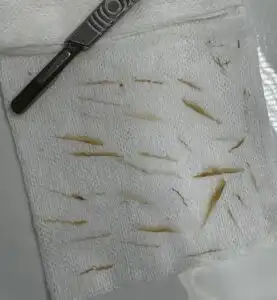
Additional vellus hair & debris build-up removed with the professional dermaplane tool from the side the at-home tool was used initially.

Leave A Comment